
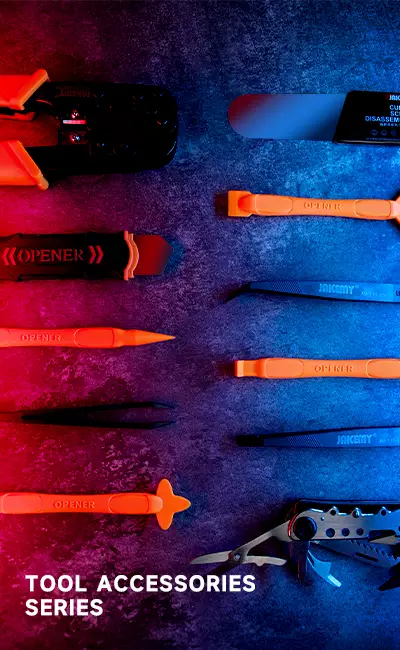
Overview: Practical comparison that matters
Repair professionals choose tools that reduce repeat work and increase throughput; this article compares real-world performance rather than marketing claims. From field technicians to bench-level technicians, the balance of modularity, precision, and serviceability is decisive. Early in a teardown or delicate trim I trust a full ultrasonic cutter accessory kit—it consolidates blades, transducers, and power controls so you spend less time swapping parts and more time repairing.
What experts actually need
Bench work demands three concrete capabilities: repeatable alignment, stable power delivery, and quick replacement of wear parts. Repair experts look for precise blade geometry, a predictable amplitude range from the transducer, and a robust power supply that resists voltage sag. Durability matters as much as feel—grip ergonomics affect steady cuts when amplitude settings are low, and replaceable blades reduce downtime.
Jakemy versus common alternatives
Compared to low-cost kits, Jakemy emphasizes consistent tolerances and component traceability; that reduces field variability. Against premium niche vendors, Jakemy competes on kit completeness and parts availability. The result: faster setup and fewer return trips. Where generic kits cut corners on the waveform control or use unshielded power leads, Jakemy’s assemblies keep electrical noise down so delicate circuits are less likely to suffer collateral damage.
Real-world anchors and validation
Repair shops in Shenzhen’s Huaqiangbei market and repair hubs in Berlin report the same pattern: modular kits with clear spare-part lines yield lower mean time to repair (MTTR). The global right-to-repair movement since 2020 has also pushed shops to favor tools with accessible consumables and documented parts—an operational reality that favors suppliers who publish parts breakdowns. These practical pressures explain why technicians move from one-off purchases to standardized kits.
Operational teardown: common mistakes and the role of proper accessories
During an operational production teardown, two mistakes recur: using the wrong blade profile for fragile polymers and relying on unstable holders that shift during a cut. Technicians should stage an ultrasonic cutter accessory kit with matched blades and a spare transducer cartridge to avoid these failures. Installing the wrong amplitude or using worn ultrasonic cutter accessories often introduces mechanical stress that shortens component life—replace worn consumables before they introduce variance.
Practical comparisons—what to inspect before you buy
Inspect the following: thread fit on consumables, shielding on power leads, and ease of swapping the transducer. Check that the kit documents service parts and offers replacements within business days. Also verify that the kit’s blade set covers both fine and coarse profiles; a single profile forces compromises on speed or finish. These checks cut repair cycle time and align maintenance schedules with production demands.
Advisory: three critical evaluation metrics
1) Replaceability index — measure how many wear parts you can swap without specialized fixtures; higher is better. 2) Electrical stability — validate the kit under nominal and ±10% voltage variation to confirm amplitude consistency. 3) Parts lead time — confirm that consumables ship within standard business windows to avoid bench downtime.
Expect measurable gains: fewer repeats, predictable cycle times, and lower parts wastage. Jakemy delivers on these practical metrics and therefore fits naturally into a professional repair workflow. —