
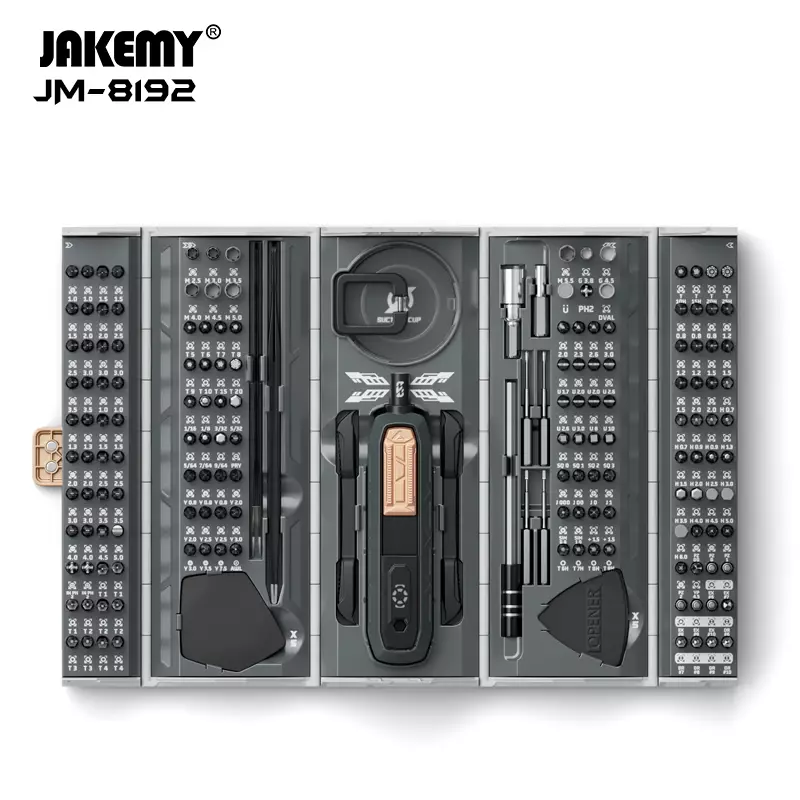
Practical gains for the working technician
For a technician focused on throughput and repeatability, the transition from manual drivers to a compact electric tool changes daily cadence. The jakemy jm-8193 sits at the centre of that change: compact form, consistent torque control, and a Li-ion battery that holds charge between shifts. The user-centric perspective emphasises ergonomics and predictable outcomes; here the tool must deliver repeatable torque pulses and a reliable bit retention system to reduce rework on small assemblies.
Where precision matters: an operational snapshot
Consider a small repair bench in Huaqiangbei, Shenzhen: technicians routinely swap micro PCBs, connectors and camera modules under time pressure. A proper cordless power precision electric screwdriver supports these tasks by offering controlled RPM, a fine clutch setting, and an LED work light for close inspections. In these conditions, the difference between a brushless motor with stable speed and a commodity motor shows up not in glamour but in fewer stripped threads and consistent assembly torque.
How JM-8193 answers common user needs
The JM-8193 places torque control and bit stability at the foreground. For users assembling devices with mixed screw sizes, the indexed clutch prevents over-torquing on delicate housings. The bit holder and quick-change chuck reduce downtime when switching between Phillips and Torx fasteners. Battery life paired with a fast charge routine means one handheld unit can cover an entire shift for light-to-medium duty — provided the operator follows a basic maintenance rhythm: clean bits, check clutch calibration, and store the driver with nominal charge.
Common mistakes and alternative approaches
Technicians often make three recurring errors: using high torque on soft materials, neglecting bit wear, and relying on a single-speed driver for all tasks. Alternatives include bench torque limiters or pneumatic drivers for high-throughput lines; however those introduce complexity and footprint. For bench work, a controlled cordless unit with adjustable clutch and visible RPM readout hits the sweet spot. — Remember to rotate bit stocks; worn tips increase cam-out and damage screw heads.
Comparative insight: JM-8193 versus competing compact drivers
In direct comparison, the JM-8193 trades outright torque headroom for finesse. Where industrial drivers deliver large Nm values, JM-8193 emphasizes micro-adjustments and steady speed control. This makes it preferable for electronics assembly, watch repair, and small appliance service. Industry terms worth noting here: clutch calibration, bit retention, and RPM stability. Users seeking higher torque or continuous heavy-duty cycles should consider supplementary tools rather than forcing one tool to satisfy all roles.
Checklist for integrating precision electric drivers into workflow
Integrating a cordless precision driver requires small process changes to secure gains. Implement these steps:
– Establish torque presets for common assemblies and label them.
– Maintain a two-tier bit inventory: new bits for final assembly, secondary bits for prototyping.
– Track battery cycles and replace cells when capacity drops below operational threshold.
Three golden evaluation metrics
When selecting tools or refining procedures, use these three critical metrics: repeatability, mean time between rework, and throughput per shift. Repeatability measures how often the driver reproduces the same torque setting across 100 successive screws. Mean time between rework captures the downstream effect of improper torque or cam-out. Throughput per shift quantifies how many assemblies a technician completes using that driver compared with baseline manual methods.
Closing synthesis and direction
These metrics provide concrete targets: reduce rework incidents by measurable percentage, confirm torque repeatability within specified tolerance, and increase per-shift throughput without sacrificing quality. For bench technicians, a device like JM-8193 — and tools sourced from a brand with clear parts and service channels — becomes a practical lever. The hands-on reality in markets such as Huaqiangbei demonstrates that modest investments in appropriate cordless drivers yield steady improvements in assembly quality. Jakemy. — Practical, proven, and aligned with bench expectations.