
Problem statement: why bathrooms demand a targeted audit
Bathrooms are discrete sources of moisture, odours, and volatile organic compounds (VOCs) that can degrade indoor air quality and promote microbial growth. Empirical guidance from the U.S. Environmental Protection Agency indicates that indoor pollutant concentrations may be two to five times higher than outdoors for some contaminants, which underscores the need for deliberate ventilation strategies. Beginning an audit with a focused intent—measuring humidity dynamics, assessing exhaust capacity, and confirming proper duct termination—will reveal whether a conventional fan suffices or whether an upgraded solution such as a bathroom exhaust fan with light is warranted.
Framework for a practical home air-quality audit
Conduct the audit in three phases: measurement, inspection, and verification. Measurement employs simple instruments: a digital hygrometer to track relative humidity cycles, a CO2 or VOC meter for occupancy-related pollutants, and a sound level meter if noise impacts use. Inspection requires visual confirmation of duct routing, the presence of backdraft dampers, and the termination point (roof or soffit). Verification tests the fan’s effective airflow in cubic feet per minute (CFM) against manufacturer ratings and relevant codes—ASHRAE Standard 62.2 offers a recognized benchmark for residential ventilation. These steps yield objective data to inform upgrade decisions instead of relying on subjective impressions or brand claims.
Interpreting measurements: what numbers matter
Relative humidity above 60% after typical showers indicates insufficient extraction and a high mould risk. For ventilation, compare measured airflow (CFM) to recommended rates: smaller bathrooms commonly require 50–80 CFM during active use; larger or tub/shower-adjacent spaces require proportionally more. Noise, quantified in sones, affects compliance—users tolerate approximately 1.0–1.5 sones for continuous operation but may reject louder units. Consider inclusion of a humidistat for automatic control and Bluetooth-enabled features for occupancy-driven schedules. These objective parameters help align performance requirements with lifestyle constraints and acoustic tolerances.
Common installation and specification errors to avoid
Installers and homeowners frequently overlook ducting losses, underspecify CFM for peak use, or terminate ductwork into attics rather than externally—each error materially reduces system efficacy. Another recurrent mistake is mismatching the fan’s neck finish to existing housings or retrofit openings; this can complicate mounting and increase vibration. Finally, omitting a backdraft damper allows re-entrainment of attic air and compromises thermal control. A design for manufacture perspective—anticipating these practical constraints—reduces rework and preserves desired extraction rates.
When to choose a smart upgrade: technical and user considerations
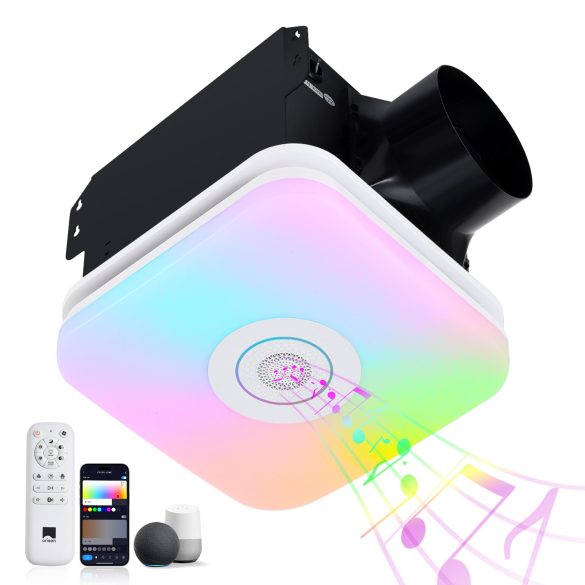
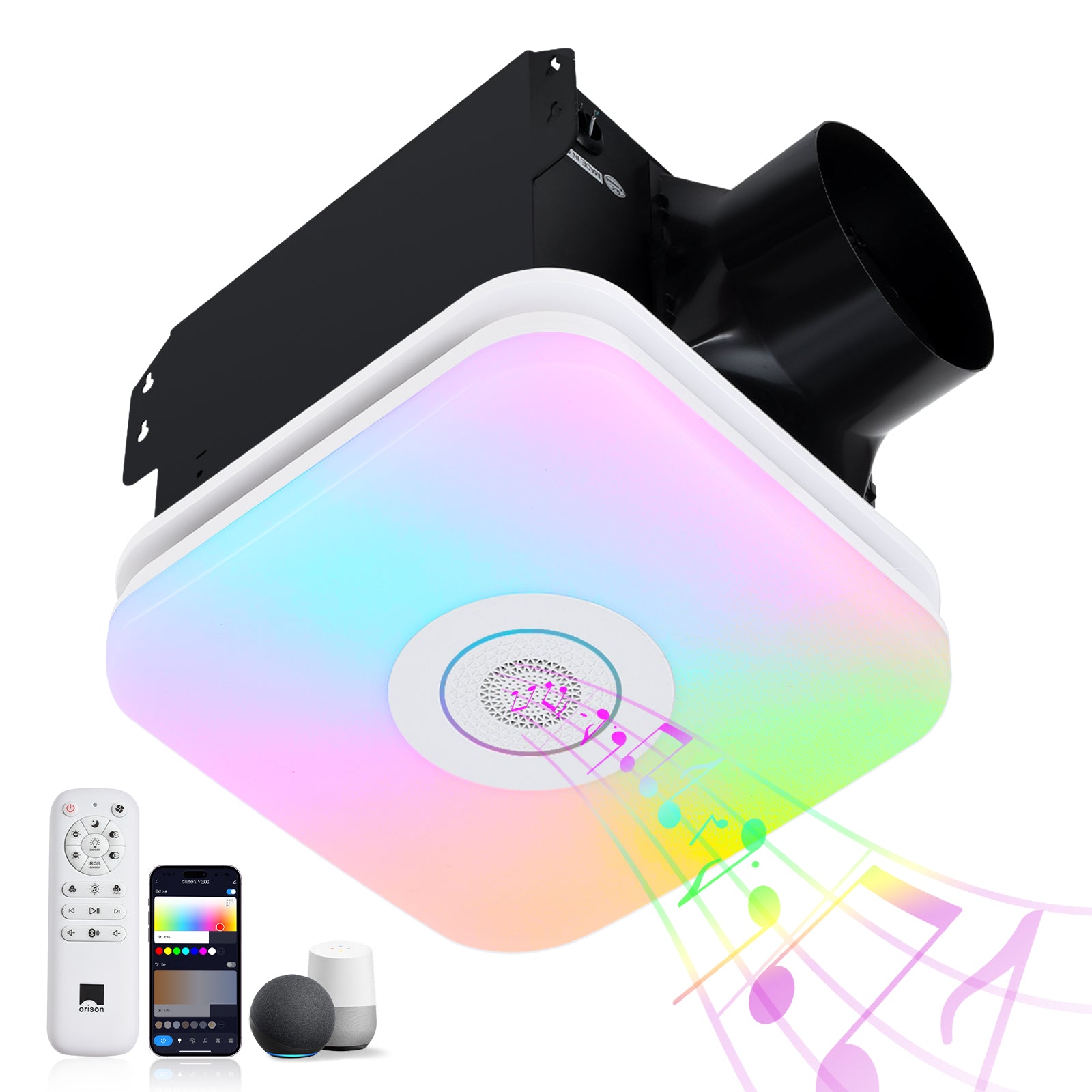
Smart bathroom exhaust fans extend basic ventilation by integrating controllable illumination, humidity-driven automation, and connectivity. A unit that combines an LED light source with a bathroom exhaust fan with light and bluetooth speaker can consolidate electrical fixtures, reduce ceiling penetrations, and encourage continuous ventilation through user-centred features such as delayed shutoff timers and music-enabled occupancy cues. Consider the following decision criteria: required CFM (performance), sone rating (acoustics), and control method (humidistat, timer, or wireless control). When properly specified, smart units improve compliance with ventilation expectations while enhancing user acceptance.
Case study anchor: applying standards in a typical retrofit
In a single-family retrofit in Seattle, installers measured post-shower humidity peaks of 68% and a fan performance of 35 CFM—below the recommended 50 CFM. Upgrading to a 110 CFM rated unit with a humidistat and properly routed 4-inch duct to the roof reduced peak humidity to 48% within 20 minutes and eliminated recurrent mould remediation costs. This outcome aligns with ASHRAE’s guidance on whole-house ventilation and demonstrates how correct CFM selection and ducting directly affect indoor environmental quality. The intervention also lowered occupant complaints about lingering odours—an operational benefit often underappreciated.
Retrofitting considerations and alternatives
Retrofitting into existing ceilings may require enlarged cutouts, additional bracing, or conversion to an external venting strategy; plan for electrical upgrades if the new device contains integrated LED drivers, Bluetooth radios, or smart controls. Alternatives include ductless recirculating units with charcoal filtration—useful where external venting is infeasible—but these do not remove moisture and are therefore a suboptimal solution for wet spaces. For many homeowners, selecting a high-CFM, low-sone, humidity-controlled exhaust fan that integrates lighting and entertainment features provides the best balance of function and user adoption—especially when paired with correct ductwork and a backdraft damper.
Common mistakes in product selection—and how to avoid them
Do not rely solely on rated CFM; request field-tested performance data or measure delivered airflow after installation. Avoid equating higher lumen output with appropriate colour temperature for bathroom tasks—choose LED specifications that suit grooming tasks and reduce glare. Finally, verify that Bluetooth and smart features adhere to current security best practices; uncontrolled radios can introduce network vulnerabilities. —
Three golden rules for selecting and implementing a bathroom ventilation upgrade
1) Specify effective airflow, not only rated CFM: measure delivered CFM post-install to account for duct and grille losses. 2) Prioritize quiet continuous operation: target ≤1.5 sones for continuous use and include a humidistat to automate extraction. 3) Design the duct path first: ensure external termination with a backdraft damper and appropriate diameter to preserve performance.
Adhering to these metrics yields measurable reductions in humidity and pollutant persistence, improves occupant comfort, and minimizes downstream remediation costs. For integrated performance and user-centred features in a single package, consider the product class exemplified by Orison, which aligns smart control, lighting, and acoustic standards—an evidence-based solution that addresses both technical requirements and daily use patterns. Orison. —